
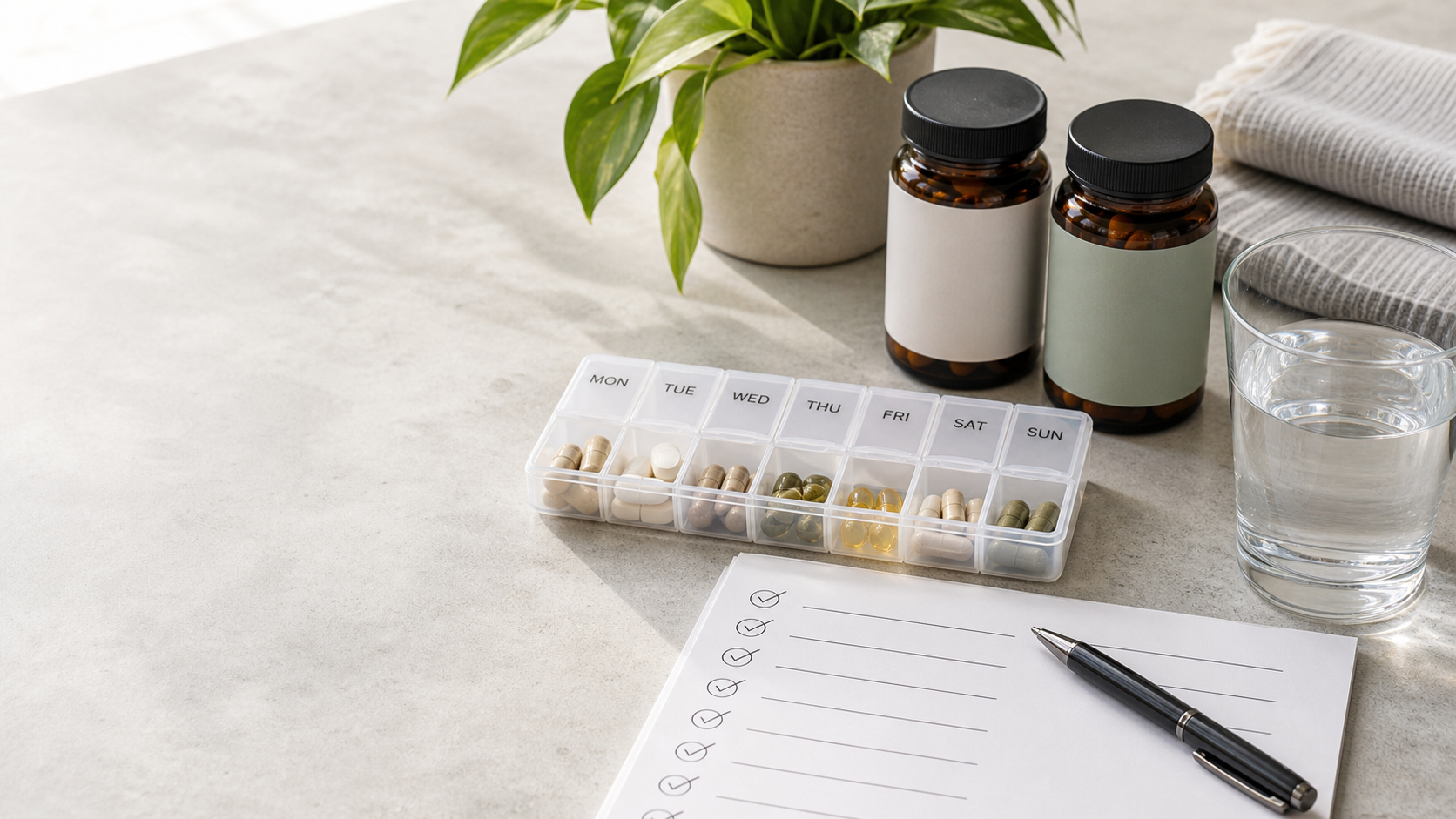
The short answer: sometimes, but there is no universal “safe stack.” The right answer depends on the ingredients, amounts, medicines you take, health conditions, and why you are using each product.
The safest place to start
Make one complete list of every prescription medicine, over-the-counter medicine, vitamin, mineral, herb, powder, tea, and gummy you use. Include the serving size and how often you take it. Review that list with a pharmacist or other qualified healthcare professional before adding another product.
Table of contents
- Why combinations need review
- The 7-point supplement checklist
- Does timing solve interactions?
- When to ask before taking anything new
- Questions to ask before buying
Why supplement combinations need review
Dietary supplements can contain vitamins, minerals, amino acids, enzymes, and botanicals. “Natural” does not automatically mean risk-free. The U.S. Food and Drug Administration explains that some supplement ingredients can change how a medicine is absorbed, metabolized, or eliminated. That can make a medication too weak or too strong.
Combining products also makes it easier to accidentally repeat an ingredient. A multivitamin, a sleep blend, and a “daily wellness” formula may all contain the same vitamin or mineral. The front label may not make that overlap obvious; the Supplement Facts panels do.
The NIH Office of Dietary Supplements recommends keeping a complete record of supplements and medicines, including dose, frequency, and reason for use, and sharing that record with healthcare providers.
A 7-point checklist before taking multiple supplements
1. Define one goal for each product
Write down why each product is in your routine. If two products serve the same goal, compare them instead of automatically taking both. A simpler routine is easier to evaluate and less likely to hide unnecessary overlap.
2. Compare serving sizes, not just ingredient names
Read the serving size at the top of every Supplement Facts panel. One product may list amounts per capsule while another lists amounts per two-capsule serving. Add the daily amounts from every source, including multivitamins, fortified drinks, powders, and gummies.
3. Look for duplicate vitamins, minerals, and botanicals
Create a simple table with one row per ingredient and one column per product. Pay special attention to formulas marketed for broad goals such as energy, immunity, calm, sleep, or general wellness because blends may share ingredients.
| Check | What to record | Why it matters |
|---|---|---|
| Serving size | Capsules, teaspoons, or scoops per serving | Prevents undercounting the daily amount |
| Ingredient amount | mg, mcg, IU, or other listed unit | Reveals duplicate intake across products |
| Other ingredients | Allergens, sweeteners, capsule materials | Helps compare formulations and restrictions |
| Warnings | Medication, surgery, pregnancy, age guidance | Identifies questions for a professional |
4. Check medicines and medical conditions
Do not rely on a generic online interaction checker as your only safeguard. Bring the full list to a pharmacist or clinician who can review the exact medicines, amounts, and health conditions involved.
One well-documented example is vitamin K and warfarin. The NIH vitamin K fact sheet notes that sudden changes in vitamin K intake can change warfarin’s effect. The practical lesson is not to remove an ingredient on your own; it is to keep healthcare providers informed and follow their instructions.
5. Add one new product at a time
Starting several products together makes it difficult to know which one caused a benefit, side effect, or tolerance problem. Unless a healthcare professional gives you a different plan, a one-change-at-a-time approach creates a clearer record.
6. Follow the label and track what changes
Use only the labeled serving unless a qualified professional advises otherwise. Record the start date, amount, and any unexpected symptoms. The National Center for Complementary and Integrative Health advises following label instructions and stopping use and contacting a healthcare provider if side effects occur.
7. Reassess the routine instead of adding indefinitely
A supplement routine should not become a permanent collection by default. Periodically ask whether each item still has a clear purpose, whether the label has changed, and whether your medicines or health status have changed.
Can you avoid an interaction by taking products at different times?
Sometimes timing matters, but spacing products apart is not a universal fix. Certain minerals can affect the absorption of some medicines, and some products have food-related instructions. Other interactions involve metabolism or bleeding risk and cannot be solved by moving a capsule from morning to evening. Follow the product label and medication instructions, then confirm any timing plan with a pharmacist.
Ask a healthcare professional before adding a supplement if:
- You take prescription or over-the-counter medicine.
- You are pregnant, breastfeeding, preparing for surgery, or recovering from a procedure.
- The product is intended for a child or teenager.
- You have a diagnosed health condition or a history of allergic reactions.
- You use a blood thinner, transplant medicine, heart medicine, antidepressant, birth control, or another medicine with important interaction concerns.
- You experienced a new or unexpected symptom after starting a product.
The FDA specifically warns that supplements can interact with medicines and that some products may need to be stopped before surgery under professional guidance. Do not stop a prescribed medicine or change its dose on your own.
Five questions to ask before buying another supplement
- What specific goal does this product serve?
- Does another product I use contain the same ingredient?
- What is the total daily amount from all sources?
- Does the label include a warning that applies to me?
- Who can review this combination with my medicines and health history?
Shop with a clearer plan
Choose one wellness goal first, then compare complete product labels before adding anything to your routine.
Frequently asked questions
How many supplements can you take at once?
There is no evidence-based number that is safe for everyone. Safety depends on the exact ingredients, amounts, medicines, health conditions, and individual needs.
Is it safe to take vitamins and herbal supplements together?
It may be appropriate in some situations, but “vitamin” and “herbal” are broad categories. Compare labels for overlap and have the full combination reviewed when medicines or health conditions are involved.
Should I take all supplements in the morning?
Not necessarily. Some labels specify use with food or at a certain time. Timing can matter for absorption and medication interactions, so follow labels and ask a pharmacist about your exact list.
What should I bring to a pharmacist?
Bring a list or photos of every product label, serving size, frequency, prescription medicine, and over-the-counter medicine you use.
Sources
- FDA: Mixing Medications and Dietary Supplements Can Endanger Your Health
- NIH Office of Dietary Supplements: Dietary Supplements—What You Need to Know
- NCCIH: Using Dietary Supplements Wisely
- NIH Office of Dietary Supplements: Vitamin K Fact Sheet for Consumers
This article is for general education and is not medical advice. Dietary supplements are not intended to diagnose, treat, cure, or prevent disease. Consult a qualified healthcare professional about your individual needs.